
ZenMux Adds TypeSafe’s Jev 1.13 for Fast, Structured AI Decisions
Singapore - September 23, 2026 - PRESSADVANTAGE - ZenMux has added TypeSafe’s Jev 1.13 to its model catalog, giving
Press Release Disclaimer: This is a press release distributed through the XPR Media network. It has not been independently verified by our newsroom.

Singapore – September 23, 2026 – PRESSADVANTAGE –
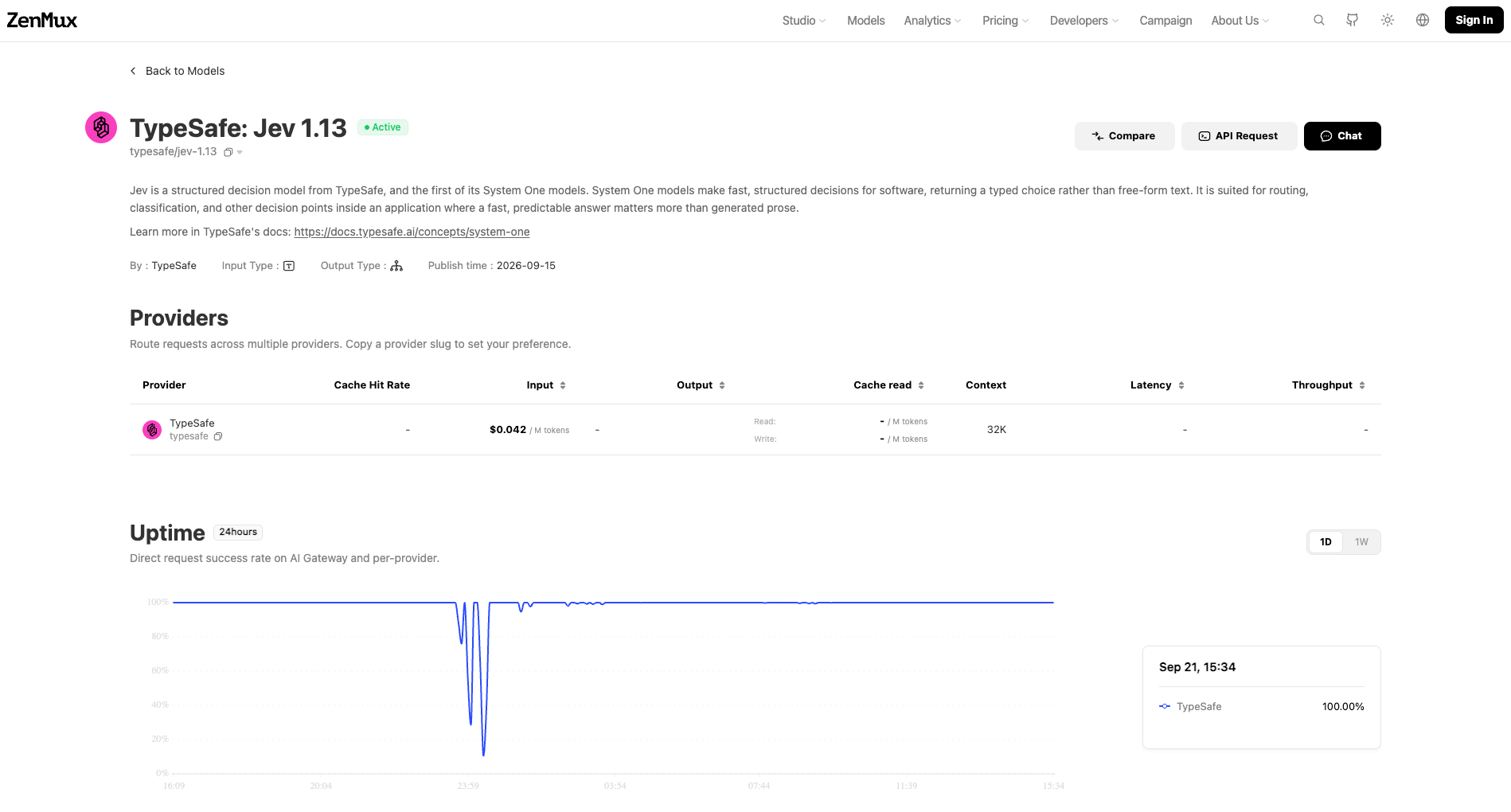
ZenMux has added TypeSafe’s Jev 1.13 to its model catalog, giving developers access to a specialized system for fast, structured decisions through the ZenMux platform. The newly available ZenMux Jev route is intended for software workflows that need a typed result, such as a classification, score, or bounded choice, rather than free-form generated text.
The ZenMux model page identifies TypeSafe as the provider and lists Jev 1.13 as active, with a publication date of September 15, 2026. ZenMux also lists text as the supported input type and a 32,000-token context window for the route, providing developers with a clear reference point when evaluating how the model may fit into an application.
TypeSafe describes Jev as its flagship model and the first model in its System One category. Unlike a general-purpose large language model that writes prose, code, or explanations, Jev evaluates supplied state and returns typed answers and probabilities that application code can inspect directly. This narrower output design is intended for decision points where the available answers are defined before a request is sent.
TypeSafe’s documentation presents three primary decision primitives for System One models. Choice selects from a closed set of developer-defined options, Score places an input on a defined numerical scale, and Noul evaluates a true-or-false proposition as a probability. These formats can support tasks such as ticket routing, content classification, risk triage, workflow branching, and verification when the application needs a constrained result instead of a generated response.
The addition gives ZenMux users a different model category alongside the generative systems commonly used for chat, writing, coding, and multimodal tasks. A development team can use Jev for a bounded judgment and then let application logic determine the next step, including routing a case to a person, invoking another model, or applying a deterministic business rule. Jev supplies a decision signal; the surrounding software remains responsible for interpreting that result and taking action.
According to TypeSafe’s official documentation, Jev currently accepts text input only. The supplied state may take the form of a string, a JSON object, or an array of text values, while images, audio, and video are not supported as direct inputs. The documentation also notes that probability calibration is measured across groups of predictions and does not guarantee that every individual answer will be correct.
That distinction is relevant for production use because structured output does not remove the need for evaluation, thresholds, or human review. Development teams can test the model against representative data, examine how confidence behaves across cases, and establish escalation rules for decisions that fall below an acceptable threshold. High-impact workflows may also require deterministic checks and human oversight regardless of the returned probability.
ZenMux’s listing of ZenMux Jev 1.13 provides the model identifier typesafe/jev-1.13 and current route information in one place. The page currently shows a single TypeSafe provider route, so teams should treat the live ZenMux listing as the source of truth for availability and should not assume that the model has multi-provider redundancy.
The release expands the types of workloads represented in the ZenMux catalog. Instead of using a generative model to produce a label and then parsing the response, developers can evaluate Jev for workflows where the output structure is defined in advance and consumed directly by software. This approach may simplify integration at repeated decision points, while leaving open-ended writing and reasoning tasks to models designed for those purposes.
ZenMux’s model page and TypeSafe’s documentation provide complementary information for implementation planning. The ZenMux page records route-specific availability and context details, while TypeSafe documents the System One concepts, accepted inputs, primitives, probabilities, and confidence fields. Developers can review both sources before selecting question definitions, evaluating outputs, and setting safeguards for a production workflow.
By adding Jev 1.13, ZenMux is extending its catalog beyond general-purpose generation to include a model designed around machine-consumed decisions. The launch gives software teams another option for classification, scoring, routing, and verification tasks where a typed answer and explicit probability are more useful than a paragraph of generated text.
About ZenMux:
ZenMux is an enterprise-grade large model aggregation platform with an insurance payout mechanism. The platform provides one-stop access to the latest models across providers. When issues such as poor output quality or excessive latency occur during use, our intelligent insurance detection and payout mechanism automatically compensates, addressing enterprise concerns around AI hallucinations and unstable quality.
###
For more information about ZenMux, contact the company here:
ZenMux
Ember
ember@zenmux.ai
Singapore
